4.2 sec in total
349 ms
3.3 sec
594 ms
Click here to check amazing CHANGELOG content. Otherwise, check out these important facts you probably never knew about changelog.md
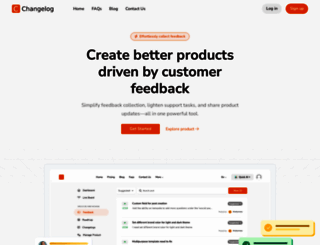
Product feedback collection, analyze insights, build actionable roadmaps, and keep users informed with CHANGELOG.md
Visit changelog.mdWe analyzed Changelog.md page load time and found that the first response time was 349 ms and then it took 3.9 sec to load all DOM resources and completely render a web page. This is a poor result, as 65% of websites can load faster.
changelog.md performance score
name
value
score
weighting
Value3.7 s
30/100
10%
Value5.2 s
23/100
25%
Value8.1 s
21/100
10%
Value4,010 ms
1/100
30%
Value0
100/100
15%
Value14.0 s
10/100
10%
349 ms
574 ms
327 ms
312 ms
320 ms
Our browser made a total of 62 requests to load all elements on the main page. We found that 92% of them (57 requests) were addressed to the original Changelog.md, 2% (1 request) were made to Pagead2.googlesyndication.com and 2% (1 request) were made to Googletagmanager.com. The less responsive or slowest element that took the longest time to load (1.2 sec) belongs to the original domain Changelog.md.
Page size can be reduced by 329.4 kB (27%)
1.2 MB
884.6 kB
In fact, the total size of Changelog.md main page is 1.2 MB. This result falls beyond the top 1M of websites and identifies a large and not optimized web page that may take ages to load. 55% of websites need less resources to load. Images take 873.3 kB which makes up the majority of the site volume.
Potential reduce by 46.4 kB
HTML content can be minified and compressed by a website’s server. The most efficient way is to compress content using GZIP which reduces data amount travelling through the network between server and browser. This page needs HTML code to be minified as it can gain 18.2 kB, which is 33% of the original size. It is highly recommended that content of this web page should be compressed using GZIP, as it can save up to 46.4 kB or 85% of the original size.
Potential reduce by 231.5 kB
Image size optimization can help to speed up a website loading time. The chart above shows the difference between the size before and after optimization. Obviously, CHANGELOG needs image optimization as it can save up to 231.5 kB or 27% of the original volume. The most popular and efficient tools for JPEG and PNG image optimization are Jpegoptim and PNG Crush.
Potential reduce by 23 B
It’s better to minify JavaScript in order to improve website performance. The diagram shows the current total size of all JavaScript files against the prospective JavaScript size after its minification and compression. This website has mostly compressed JavaScripts.
Potential reduce by 51.5 kB
CSS files minification is very important to reduce a web page rendering time. The faster CSS files can load, the earlier a page can be rendered. Changelog.md needs all CSS files to be minified and compressed as it can save up to 51.5 kB or 23% of the original size.
Number of requests can be reduced by 34 (63%)
54
20
The browser has sent 54 CSS, Javascripts, AJAX and image requests in order to completely render the main page of CHANGELOG. We recommend that multiple CSS and JavaScript files should be merged into one by each type, as it can help reduce assets requests from 20 to 1 for JavaScripts and from 16 to 1 for CSS and as a result speed up the page load time.
changelog.md
349 ms
changelog.md
574 ms
fontawesome.css
327 ms
owl.carousel.min.css
312 ms
owl.theme.default.min.css
320 ms
magnific-popup.css
351 ms
simplebar.min.css
352 ms
typing-text.css
351 ms
animate.css
415 ms
swiper-bundle.min.css
426 ms
snackbar.min.css
431 ms
bootstrap.min.css
541 ms
style.css
556 ms
responsive.css
446 ms
app.css
517 ms
custom.css
530 ms
dark.css
536 ms
adsbygoogle.js
56 ms
js
117 ms
jquery.min.js
666 ms
jquery.form.js
725 ms
bootstrap.min.js
743 ms
owl.carousel.min.js
642 ms
carousel-thumbs.min.js
645 ms
jquery.magnific-popup.js
664 ms
mixitup.min.js
749 ms
simplebar.min.js
753 ms
appear.min.js
773 ms
typing-text.js
775 ms
wow.min.js
827 ms
swiper-bundle.min.js
956 ms
swiper.js
855 ms
snackbar.min.js
857 ms
user-ajax.js
882 ms
custom.js
883 ms
script.js
928 ms
css2
478 ms
helper.css
411 ms
index
59 ms
flasher.min.js
106 ms
classic-theme_footer_logo.png
107 ms
classic-theme_logo.png
187 ms
bg-pattern.png
395 ms
hero-app-screen.png
624 ms
hero-frame-left.svg
285 ms
hero-frame-right-1.svg
183 ms
hero-frame-right-2.svg
192 ms
clients-logo-1.svg
289 ms
clients-logo-2.svg
295 ms
clients-logo-3.svg
298 ms
clients-logo-4.svg
388 ms
clients-logo-5.svg
395 ms
screen1.png
732 ms
screen2.png
518 ms
screen4.png
597 ms
feedback.png
507 ms
roadmap.png
608 ms
changelog.png
619 ms
fa-regular-400.ttf
921 ms
fa-light-300.ttf
968 ms
fa-thin-100.ttf
1183 ms
fa-solid-900.ttf
943 ms
changelog.md accessibility score
ARIA
These are opportunities to improve the usage of ARIA in your application which may enhance the experience for users of assistive technology, like a screen reader.
Impact
Issue
[aria-*] attributes do not match their roles
[aria-*] attributes do not have valid values
Names and labels
These are opportunities to improve the semantics of the controls in your application. This may enhance the experience for users of assistive technology, like a screen reader.
Impact
Issue
<frame> or <iframe> elements do not have a title
Links do not have a discernible name
Navigation
These are opportunities to improve keyboard navigation in your application.
Impact
Issue
Heading elements are not in a sequentially-descending order
changelog.md best practices score
Trust and Safety
Impact
Issue
Does not use HTTPS
Ensure CSP is effective against XSS attacks
General
Impact
Issue
Detected JavaScript libraries
Browser errors were logged to the console
Missing source maps for large first-party JavaScript
changelog.md SEO score
Mobile Friendly
Make sure your pages are mobile friendly so users don’t have to pinch or zoom in order to read the content pages. [Learn more](https://developers.google.com/search/mobile-sites/).
Impact
Issue
Document uses legible font sizes
![]()
EN
![]()
EN
UTF-8
Language claimed in HTML meta tag should match the language actually used on the web page. Otherwise Changelog.md can be misinterpreted by Google and other search engines. Our service has detected that English is used on the page, and it matches the claimed language. Our system also found out that Changelog.md main page’s claimed encoding is utf-8. Use of this encoding format is the best practice as the main page visitors from all over the world won’t have any issues with symbol transcription.
changelog.md
Open Graph data is detected on the main page of CHANGELOG. This is the best way to make the web page social media friendly. Here is how it looks like on Facebook: