26 sec in total
1.7 sec
23.5 sec
826 ms
Visit jhsmr.org now to see the best up-to-date Jhsmr content and also check out these interesting facts you probably never knew about jhsmr.org
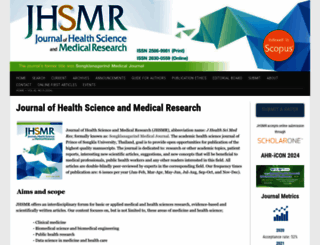
Official Journal Health Science of Prince of Songkla University
Visit jhsmr.orgWe analyzed Jhsmr.org page load time and found that the first response time was 1.7 sec and then it took 24.3 sec to load all DOM resources and completely render a web page. This is an excellent result, as only a small number of websites can load faster. Unfortunately, there were 2 request timeouts, which can generally increase the web page load time, as the browser stays idle while waiting for website response.
jhsmr.org performance score
name
value
score
weighting
Value10.7 s
0/100
10%
Value15.7 s
0/100
25%
Value13.9 s
1/100
10%
Value40 ms
100/100
30%
Value0.017
100/100
15%
Value12.1 s
16/100
10%
1670 ms
1651 ms
9 ms
486 ms
487 ms
Our browser made a total of 75 requests to load all elements on the main page. We found that 63% of them (47 requests) were addressed to the original Jhsmr.org, 15% (11 requests) were made to Fonts.gstatic.com and 5% (4 requests) were made to Google-analytics.com. The less responsive or slowest element that took the longest time to load (20.2 sec) relates to the external source Medinfo.psu.ac.th.
Page size can be reduced by 520.2 kB (26%)
2.0 MB
1.5 MB
In fact, the total size of Jhsmr.org main page is 2.0 MB. This result falls beyond the top 1M of websites and identifies a large and not optimized web page that may take ages to load. 60% of websites need less resources to load. Images take 1.4 MB which makes up the majority of the site volume.
Potential reduce by 63.9 kB
HTML content can be minified and compressed by a website’s server. The most efficient way is to compress content using GZIP which reduces data amount travelling through the network between server and browser. HTML code on this page is well minified. It is highly recommended that content of this web page should be compressed using GZIP, as it can save up to 63.9 kB or 58% of the original size.
Potential reduce by 105.1 kB
Image size optimization can help to speed up a website loading time. The chart above shows the difference between the size before and after optimization. Jhsmr images are well optimized though.
Potential reduce by 210.1 kB
It’s better to minify JavaScript in order to improve website performance. The diagram shows the current total size of all JavaScript files against the prospective JavaScript size after its minification and compression. It is highly recommended that all JavaScript files should be compressed and minified as it can save up to 210.1 kB or 59% of the original size.
Potential reduce by 141.2 kB
CSS files minification is very important to reduce a web page rendering time. The faster CSS files can load, the earlier a page can be rendered. Jhsmr.org needs all CSS files to be minified and compressed as it can save up to 141.2 kB or 90% of the original size.
Number of requests can be reduced by 29 (50%)
58
29
The browser has sent 58 CSS, Javascripts, AJAX and image requests in order to completely render the main page of Jhsmr. We recommend that multiple CSS and JavaScript files should be merged into one by each type, as it can help reduce assets requests from 30 to 1 for JavaScripts and as a result speed up the page load time.
jhsmr
1670 ms
clean-rwd.css
1651 ms
jsapi
9 ms
jquery.tag-it.js
486 ms
jquery.cookie.js
487 ms
fontController.js
494 ms
general.js
497 ms
jqueryValidatorI18n.js
729 ms
Helper.js
733 ms
ObjectProxy.js
741 ms
Handler.js
992 ms
LinkActionRequest.js
975 ms
Feature.js
979 ms
SiteHandler.js
1232 ms
UrlInDivHandler.js
1218 ms
AutocompleteHandler.js
1224 ms
ExtrasOnDemandHandler.js
1240 ms
FormHandler.js
1459 ms
AjaxFormHandler.js
1468 ms
ClientFormHandler.js
1470 ms
GridHandler.js
1736 ms
LinkActionHandler.js
1490 ms
SearchFormHandler.js
1702 ms
ReportGeneratorFormHandler.js
1953 ms
LuceneAutocompleteHandler.js
1721 ms
jquery.pkp.js
1739 ms
jquery.validate.js
1885 ms
loader.js
25 ms
urchin.js
7 ms
js
55 ms
css
25 ms
css
30 ms
jquery.min.js
21 ms
jquery-ui.min.js
34 ms
Journal%20Metrics.png
20235 ms
journal_img.php
698 ms
220px-Scopus_logo.svg.png
100 ms
googlescholar.png
1134 ms
LogoIThaijo.png
1226 ms
homeHeaderTitleImage_en_US.jpg
2183 ms
Cover-JHSMR-v25.jpg
264 ms
coverslisted1.jpg
1952 ms
Cover-JHSMR-36_no_21.jpg
1491 ms
thumbnail_cover_AHR-iCON_2024.jpg
263 ms
TCI-TSRI%201.jpg
977 ms
CiteScore2023_Journal_of_Health_Sc.png
494 ms
scholar_one_logo.png
503 ms
ahricon2024-thumbnail1.png
731 ms
General_medicine1.PNG
751 ms
info.php
968 ms
LogoMedBuleEng1.jpg
1980 ms
Logo-PSU-EH-01-1024x724.png
1440 ms
TCI_logo.png
1218 ms
asean_citation_index_logo.png
1461 ms
%E0%B8%94%E0%B8%B2%E0%B8%A7%E0%B8%99%E0%B9%8C%E0%B9%82%E0%B8%AB%E0%B8%A5%E0%B8%94.jpg
1677 ms
EuroPub-Logo.png
3147 ms
atom10_logo.gif
1738 ms
rss20_logo.gif
1916 ms
rss10_logo.gif
1987 ms
line.png
20227 ms
__utm.gif
8 ms
ieVo2ZhZI2eCN5jzbjEETS9weq8-_d6T_POl0fRJeyVVpcBO5Xk.ttf
137 ms
ieVo2ZhZI2eCN5jzbjEETS9weq8-_d6T_POl0fRJeyWyosBO5Xk.ttf
169 ms
ieVo2ZhZI2eCN5jzbjEETS9weq8-_d6T_POl0fRJeyXsosBO5Xk.ttf
188 ms
u-440qyriQwlOrhSvowK_l5-fCZJ.ttf
92 ms
u-4n0qyriQwlOrhSvowK_l521wRZWMf_.ttf
133 ms
u-4n0qyriQwlOrhSvowK_l52xwNZWMf_.ttf
135 ms
u-4n0qyriQwlOrhSvowK_l52_wFZWMf_.ttf
135 ms
u-4m0qyriQwlOrhSvowK_l5-eRZOf-c.ttf
135 ms
u-4l0qyriQwlOrhSvowK_l5-eR7lXff4jvk.ttf
135 ms
u-4l0qyriQwlOrhSvowK_l5-eR71Wvf4jvk.ttf
135 ms
u-4l0qyriQwlOrhSvowK_l5-eR7NWPf4jvk.ttf
135 ms
fontawesome-webfont.woff
2298 ms
analytics.js
98 ms
collect
13 ms
jhsmr.org accessibility score
Contrast
These are opportunities to improve the legibility of your content.
Impact
Issue
Background and foreground colors do not have a sufficient contrast ratio.
Names and labels
These are opportunities to improve the semantics of the controls in your application. This may enhance the experience for users of assistive technology, like a screen reader.
Impact
Issue
Links do not have a discernible name
Tables and lists
These are opportunities to improve the experience of reading tabular or list data using assistive technology, like a screen reader.
Impact
Issue
Lists do not contain only <li> elements and script supporting elements (<script> and <template>).
Best practices
These items highlight common accessibility best practices.
Impact
Issue
[user-scalable="no"] is used in the <meta name="viewport"> element or the [maximum-scale] attribute is less than 5.
jhsmr.org best practices score
Trust and Safety
Impact
Issue
Does not use HTTPS
Includes front-end JavaScript libraries with known security vulnerabilities
Ensure CSP is effective against XSS attacks
General
Impact
Issue
Detected JavaScript libraries
Browser errors were logged to the console
jhsmr.org SEO score
Crawling and Indexing
To appear in search results, crawlers need access to your app.
Impact
Issue
robots.txt is not valid
Mobile Friendly
Make sure your pages are mobile friendly so users don’t have to pinch or zoom in order to read the content pages. [Learn more](https://developers.google.com/search/mobile-sites/).
Impact
Issue
Document uses legible font sizes
Tap targets are not sized appropriately
![]()
EN
![]()
EN
UTF-8
Language claimed in HTML meta tag should match the language actually used on the web page. Otherwise Jhsmr.org can be misinterpreted by Google and other search engines. Our service has detected that English is used on the page, and it matches the claimed language. Our system also found out that Jhsmr.org main page’s claimed encoding is utf-8. Use of this encoding format is the best practice as the main page visitors from all over the world won’t have any issues with symbol transcription.
jhsmr.org
Open Graph description is not detected on the main page of Jhsmr. Lack of Open Graph description can be counter-productive for their social media presence, as such a description allows converting a website homepage (or other pages) into good-looking, rich and well-structured posts, when it is being shared on Facebook and other social media. For example, adding the following code snippet into HTML <head> tag will help to represent this web page correctly in social networks: