7.2 sec in total
102 ms
3.1 sec
4 sec
Visit sustainable.mit.edu now to see the best up-to-date Sustainable MIT content for United States and also check out these interesting facts you probably never knew about sustainable.mit.edu
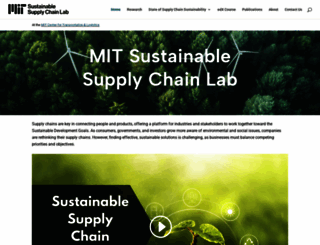
Our goal at the MIT Sustainable Supply Chain Lab is to connect sustainable research outcomes to practical settings for companies.
Visit sustainable.mit.eduWe analyzed Sustainable.mit.edu page load time and found that the first response time was 102 ms and then it took 7.1 sec to load all DOM resources and completely render a web page. This is a poor result, as 80% of websites can load faster.
sustainable.mit.edu performance score
name
value
score
weighting
Value2.9 s
53/100
10%
Value21.9 s
0/100
25%
Value18.2 s
0/100
10%
Value10,860 ms
0/100
30%
Value0.197
62/100
15%
Value33.8 s
0/100
10%
102 ms
1716 ms
113 ms
81 ms
99 ms
Our browser made a total of 68 requests to load all elements on the main page. We found that 19% of them (13 requests) were addressed to the original Sustainable.mit.edu, 22% (15 requests) were made to Fonts.gstatic.com and 21% (14 requests) were made to I0.wp.com. The less responsive or slowest element that took the longest time to load (1.7 sec) belongs to the original domain Sustainable.mit.edu.
Page size can be reduced by 771.1 kB (27%)
2.8 MB
2.1 MB
In fact, the total size of Sustainable.mit.edu main page is 2.8 MB. This result falls beyond the top 1M of websites and identifies a large and not optimized web page that may take ages to load. Only a small number of websites need less resources to load. Images take 1.9 MB which makes up the majority of the site volume.
Potential reduce by 184.4 kB
HTML content can be minified and compressed by a website’s server. The most efficient way is to compress content using GZIP which reduces data amount travelling through the network between server and browser. HTML code on this page is well minified. It is highly recommended that content of this web page should be compressed using GZIP, as it can save up to 184.4 kB or 80% of the original size.
Potential reduce by 212.8 kB
Image size optimization can help to speed up a website loading time. The chart above shows the difference between the size before and after optimization. Obviously, Sustainable MIT needs image optimization as it can save up to 212.8 kB or 11% of the original volume. The most popular and efficient tools for JPEG and PNG image optimization are Jpegoptim and PNG Crush.
Potential reduce by 30.2 kB
It’s better to minify JavaScript in order to improve website performance. The diagram shows the current total size of all JavaScript files against the prospective JavaScript size after its minification and compression. It is highly recommended that all JavaScript files should be compressed and minified as it can save up to 30.2 kB or 11% of the original size.
Potential reduce by 343.8 kB
CSS files minification is very important to reduce a web page rendering time. The faster CSS files can load, the earlier a page can be rendered. Sustainable.mit.edu needs all CSS files to be minified and compressed as it can save up to 343.8 kB or 74% of the original size.
Number of requests can be reduced by 22 (47%)
47
25
The browser has sent 47 CSS, Javascripts, AJAX and image requests in order to completely render the main page of Sustainable MIT. We recommend that multiple CSS and JavaScript files should be merged into one by each type, as it can help reduce assets requests from 16 to 1 for JavaScripts and from 8 to 1 for CSS and as a result speed up the page load time.
sustainable.mit.edu
102 ms
sustainable.mit.edu
1716 ms
js
113 ms
mediaelementplayer-legacy.min.css
81 ms
wp-mediaelement.min.css
99 ms
menu-image.css
139 ms
dashicons.min.css
101 ms
css
103 ms
frontend-gtag.min.js
96 ms
js
92 ms
js
89 ms
jquery.min.js
81 ms
jquery-migrate.min.js
52 ms
scripts.min.js
255 ms
jquery.fitvids.js
146 ms
easypiechart.js
146 ms
common.js
144 ms
e-202448.js
86 ms
gtm.js
67 ms
ahksjCist7E
244 ms
AdobeStock_633752173-scaled.jpeg
145 ms
3VBzLrF6FvA
345 ms
CTL-logo-white-2-lines-2024.png
555 ms
et-divi-dynamic-745-late.css
225 ms
SSCL_sub-brand_lockup_two-line_rgb_black.png
708 ms
moldovahighway.jpg
736 ms
mit-micro-logo-w.png
238 ms
logo-cscmp-300x141-1.jpg
126 ms
Xylem-logo-550x200-1.jpeg
156 ms
unicef_twitter1.png
156 ms
YcSIASkLFDkoiOLFeOvKhyk1fks5mXgztRifk692mRM.jpg
155 ms
Colgate-Palmolive-Logo-PNG-Transparent.png
155 ms
Dell_Logo.png
166 ms
Accenture-logo.png
167 ms
MITofficesust_2lines.png
173 ms
Starbucks_Corporation_Logo_2011.svg_.png
173 ms
PG.png
172 ms
CH_Robinson.png
173 ms
Coppel.jpg
182 ms
256px-LinkedIn_logo_initials.png
182 ms
KFOlCnqEu92Fr1MmEU9fChc9.ttf
168 ms
KFOmCnqEu92Fr1Mu7GxP.ttf
190 ms
KFOlCnqEu92Fr1MmSU5fChc9.ttf
178 ms
KFOkCnqEu92Fr1MmgVxGIzc.ttf
196 ms
KFOlCnqEu92Fr1MmWUlfChc9.ttf
229 ms
KFOlCnqEu92Fr1MmYUtfChc9.ttf
204 ms
R71RjywflP6FLr3gZx7K8UyuXDs9zVwDmXCb8lxYgmuii32UGoVldX6UgfjL4-3sMM_kB_qXSEXTJQCFLH5-_bcElhgtl658BQ.ttf
113 ms
R71RjywflP6FLr3gZx7K8UyuXDs9zVwDmXCb8lxYgmuii32UGoVldX6UgfjL4-3sMM_kB_qXSEXTJQCFLH5-_bcEliotl658BQ.ttf
125 ms
R71RjywflP6FLr3gZx7K8UyuXDs9zVwDmXCb8lxYgmuii32UGoVldX6UgfjL4-3sMM_kB_qXSEXTJQCFLH5-_bcElnQtl658BQ.ttf
141 ms
R71RjywflP6FLr3gZx7K8UyuXDs9zVwDmXCb8lxYgmuii32UGoVldX6UgfjL4-3sMM_kB_qXSEXTJQCFLH5-_bcElqotl658BQ.ttf
141 ms
R71RjywflP6FLr3gZx7K8UyuXDs9zVwDmXCb8lxYgmuii32UGoVldX6UgfjL4-3sMM_kB_qXSEXTJQCFLH5-_bcEliosl658BQ.ttf
231 ms
R71RjywflP6FLr3gZx7K8UyuXDs9zVwDmXCb8lxYgmuii32UGoVldX6UgfjL4-3sMM_kB_qXSEXTJQCFLH5-_bcElvQql658BQ.ttf
241 ms
R71RjywflP6FLr3gZx7K8UyuXDs9zVwDmXCb8lxYgmuii32UGoVldX6UgfjL4-3sMM_kB_qXSEXTJQCFLH5-_bcEls0ql658BQ.ttf
242 ms
R71RjywflP6FLr3gZx7K8UyuXDs9zVwDmXCb8lxYgmuii32UGoVldX6UgfjL4-3sMM_kB_qXSEXTJQCFLH5-_bcElqoql658BQ.ttf
230 ms
R71RjywflP6FLr3gZx7K8UyuXDs9zVwDmXCb8lxYgmuii32UGoVldX6UgfjL4-3sMM_kB_qXSEXTJQCFLH5-_bcEloMql658BQ.ttf
242 ms
modules.woff
404 ms
www-player.css
180 ms
www-embed-player.js
271 ms
base.js
271 ms
insight.min.js
296 ms
style.min.css
174 ms
error_204
4 ms
ahksjCist7E
115 ms
3VBzLrF6FvA
228 ms
insight.old.min.js
6 ms
insight_tag_errors.gif
137 ms
www-embed-player.js
30 ms
base.js
137 ms
sustainable.mit.edu accessibility score
Contrast
These are opportunities to improve the legibility of your content.
Impact
Issue
Background and foreground colors do not have a sufficient contrast ratio.
Navigation
These are opportunities to improve keyboard navigation in your application.
Impact
Issue
Heading elements are not in a sequentially-descending order
Names and labels
These are opportunities to improve the semantics of the controls in your application. This may enhance the experience for users of assistive technology, like a screen reader.
Impact
Issue
Links do not have a discernible name
Best practices
These items highlight common accessibility best practices.
Impact
Issue
[user-scalable="no"] is used in the <meta name="viewport"> element or the [maximum-scale] attribute is less than 5.
sustainable.mit.edu best practices score
Trust and Safety
Impact
Issue
Does not use HTTPS
Ensure CSP is effective against XSS attacks
User Experience
Impact
Issue
Displays images with incorrect aspect ratio
General
Impact
Issue
Detected JavaScript libraries
Page has valid source maps
sustainable.mit.edu SEO score
Content Best Practices
Format your HTML in a way that enables crawlers to better understand your app’s content.
Impact
Issue
Links do not have descriptive text
Mobile Friendly
Make sure your pages are mobile friendly so users don’t have to pinch or zoom in order to read the content pages. [Learn more](https://developers.google.com/search/mobile-sites/).
Impact
Issue
Document uses legible font sizes
![]()
EN
![]()
EN
UTF-8
Language claimed in HTML meta tag should match the language actually used on the web page. Otherwise Sustainable.mit.edu can be misinterpreted by Google and other search engines. Our service has detected that English is used on the page, and it matches the claimed language. Our system also found out that Sustainable.mit.edu main page’s claimed encoding is utf-8. Use of this encoding format is the best practice as the main page visitors from all over the world won’t have any issues with symbol transcription.
sustainable.mit.edu
Open Graph data is detected on the main page of Sustainable MIT. This is the best way to make the web page social media friendly. Here is how it looks like on Facebook: