4 sec in total
459 ms
3.4 sec
134 ms
Welcome to russelllab.org homepage info - get ready to check Russell Lab best content for United States right away, or after learning these important things about russelllab.org
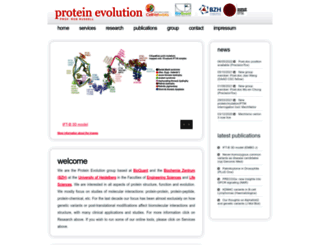
Protein Evolution Heidelberg, Prof. Rob Russell
Visit russelllab.orgWe analyzed Russelllab.org page load time and found that the first response time was 459 ms and then it took 3.6 sec to load all DOM resources and completely render a web page. This is a poor result, as 60% of websites can load faster.
russelllab.org performance score
name
value
score
weighting
Value2.7 s
59/100
10%
Value2.9 s
81/100
25%
Value7.5 s
26/100
10%
Value840 ms
34/100
30%
Value0.022
100/100
15%
Value16.5 s
5/100
10%
459 ms
210 ms
421 ms
211 ms
211 ms
Our browser made a total of 131 requests to load all elements on the main page. We found that 82% of them (108 requests) were addressed to the original Russelllab.org, 14% (18 requests) were made to Platform.twitter.com and 2% (2 requests) were made to Google-analytics.com. The less responsive or slowest element that took the longest time to load (1.4 sec) belongs to the original domain Russelllab.org.
Page size can be reduced by 6.0 MB (18%)
34.1 MB
28.1 MB
In fact, the total size of Russelllab.org main page is 34.1 MB. This result falls beyond the top 1M of websites and identifies a large and not optimized web page that may take ages to load. Only a small number of websites need less resources to load. Images take 33.9 MB which makes up the majority of the site volume.
Potential reduce by 50.4 kB
HTML content can be minified and compressed by a website’s server. The most efficient way is to compress content using GZIP which reduces data amount travelling through the network between server and browser. This page needs HTML code to be minified as it can gain 22.8 kB, which is 40% of the original size. It is highly recommended that content of this web page should be compressed using GZIP, as it can save up to 50.4 kB or 89% of the original size.
Potential reduce by 5.9 MB
Image size optimization can help to speed up a website loading time. The chart above shows the difference between the size before and after optimization. Obviously, Russell Lab needs image optimization as it can save up to 5.9 MB or 17% of the original volume. The most popular and efficient tools for JPEG and PNG image optimization are Jpegoptim and PNG Crush.
Potential reduce by 58.1 kB
It’s better to minify JavaScript in order to improve website performance. The diagram shows the current total size of all JavaScript files against the prospective JavaScript size after its minification and compression. It is highly recommended that all JavaScript files should be compressed and minified as it can save up to 58.1 kB or 57% of the original size.
Potential reduce by 11.2 kB
CSS files minification is very important to reduce a web page rendering time. The faster CSS files can load, the earlier a page can be rendered. Russelllab.org needs all CSS files to be minified and compressed as it can save up to 11.2 kB or 82% of the original size.
Number of requests can be reduced by 19 (15%)
130
111
The browser has sent 130 CSS, Javascripts, AJAX and image requests in order to completely render the main page of Russell Lab. We recommend that multiple CSS and JavaScript files should be merged into one by each type, as it can help reduce assets requests from 20 to 1 for JavaScripts and as a result speed up the page load time.
russelllab.org
459 ms
default.css
210 ms
jquery-1.4.2.min.js
421 ms
jquery.slidertron-0.1.js
211 ms
gallery.css
211 ms
widgets.js
17 ms
ga.js
49 ms
img01.jpg
110 ms
cellnetworks.gif
112 ms
bioquant.png
111 ms
bzh_logo_neuen.jpg
210 ms
img05.jpg
110 ms
img04.jpg
204 ms
img06.jpg
205 ms
WeSA_2.png
612 ms
WeSA_1.png
723 ms
STXBP1_2.png
628 ms
STXBP1_1.png
1010 ms
ALK_2.png
708 ms
ALK_1.png
312 ms
FL_2023.jpg
830 ms
F1000_1.jpg
715 ms
SignalP_QC_TM_1.jpg
732 ms
het_not_hom_2.png
1012 ms
het_not_hom_1.png
819 ms
DHHC-PAT_2.png
1180 ms
DHHC-PAT_1.png
1046 ms
precogx_1.jpeg
921 ms
KDM4C_1.png
936 ms
jmb_alphafold2_3.jpg
1025 ms
jmb_alphafold2_1.jpg
1041 ms
mechnetor-01.svg
1110 ms
mechnetor-02.svg
1157 ms
Munc18_VAMP2_SNARE_1.png
1231 ms
RhoGAP19D.png
1250 ms
NBAS_phenotypes.PNG
1182 ms
MYC_N_0.PNG
1213 ms
MYC_N_1.PNG
1216 ms
Oncofamily_5.PNG
1243 ms
Oncofamily_4.PNG
1258 ms
Oncofamily_3.PNG
1415 ms
Oncofamily_2.PNG
1320 ms
Oncofamily_1.PNG
1303 ms
__utm.gif
17 ms
widget_iframe.2f70fb173b9000da126c79afe2098f02.html
21 ms
GPCR_review_1.PNG
1246 ms
GPCR_0.jpg
1252 ms
GPCR_8.PNG
1256 ms
GPCR_7.PNG
1315 ms
settings
70 ms
timeline.e108540dddc96e4b707f5cf259a582d7.js
3 ms
GPCR_6.PNG
1240 ms
GPCR_5.PNG
1256 ms
GPCR_4.PNG
1256 ms
MechismoNews
137 ms
logo_neu_204x107.jpg
453 ms
GPCR_3.PNG
1159 ms
polyfills-a40ef1678bae11e696dba45124eadd70.js
4 ms
runtime-b1c52fd0a13ead5fcf6b.js
20 ms
modules-96ebc7ac3ad66d681a3d.js
24 ms
main-babd9234dc048fb47339.js
32 ms
_app-a9c9f1a99e4414675fb1.js
22 ms
%5BscreenName%5D-0517bdda27d5006a5a2d.js
22 ms
_buildManifest.js
22 ms
_ssgManifest.js
57 ms
8526.0c32a8f0cfc5749221a3.js
10 ms
1755.07a49c40b12af4f75780.js
11 ms
8283.f3e5048cca7cef5eed7f.js
3 ms
3077.44bfeb00af01bc4020f6.js
9 ms
1362.42d432e02f7980bca032.js
8 ms
4956.c4e51ef593974b9db0bb.js
21 ms
5893.d500bd2a89ded806aa73.js
20 ms
GPCR_2.PNG
910 ms
GPCR_1.PNG
899 ms
PRECOG_1.PNG
840 ms
PRECOG_2.PNG
852 ms
PRECOG_3.PNG
849 ms
ciliacarta_1.PNG
850 ms
PARP1_chordoma.PNG
908 ms
EZHIP_cover.png
798 ms
CXorf67_2.PNG
733 ms
CXorf67_1.PNG
743 ms
BL_2019_2.PNG
671 ms
BL_2019_1.PNG
675 ms
NFRKB_Blood.PNG
707 ms
LRRK2_Mov_Dis.PNG
822 ms
EB_2018_1.png
737 ms
FEBS_2018_1.PNG
628 ms
FEBS_2018_2.PNG
614 ms
FEBS_2018_3.PNG
649 ms
FIC1.png
652 ms
FIC2.png
681 ms
FIC3.png
672 ms
DRY_1.png
668 ms
DRY_2.png
689 ms
psites3.png
797 ms
psites2.png
709 ms
psites4.jpg
675 ms
mech_cancer3.png
663 ms
mech_cancer4.png
652 ms
mech_cancer2.png
676 ms
mech_cancer1.png
707 ms
ffv_gag_1.png
688 ms
Syscilia1.png
685 ms
Syscilia2.png
670 ms
Syscilia3.png
680 ms
Syscilia4.png
687 ms
mechismo_vs_modelling.png
704 ms
mechismo_rhoa.png
689 ms
mechismo_pancreatic.png
699 ms
siRNA_PPI_big.PNG
689 ms
RhoA_big.PNG
679 ms
JAK3_big.PNG
688 ms
Ago_big.PNG
706 ms
TCF4_ID3.gif
1107 ms
Medulloblastoma_front.PNG
675 ms
Gag_correlated_front.PNG
661 ms
Negatives_front.PNG
667 ms
mycomod1.png
673 ms
slideshow5.jpg
666 ms
wikipedia1.png
704 ms
slideshow2.jpg
662 ms
pepsite2.png
666 ms
slideshow3.png
667 ms
slideshow4.png
662 ms
slideshow1.png
709 ms
img08.jpg
685 ms
img07.jpg
661 ms
img09.jpg
665 ms
img10.jpg
698 ms
img11.jpg
719 ms
russelllab.org accessibility score
Contrast
These are opportunities to improve the legibility of your content.
Impact
Issue
Background and foreground colors do not have a sufficient contrast ratio.
Internationalization and localization
These are opportunities to improve the interpretation of your content by users in different locales.
Impact
Issue
<html> element does not have a [lang] attribute
Tables and lists
These are opportunities to improve the experience of reading tabular or list data using assistive technology, like a screen reader.
Impact
Issue
Lists do not contain only <li> elements and script supporting elements (<script> and <template>).
russelllab.org best practices score
Trust and Safety
Impact
Issue
Does not use HTTPS
Includes front-end JavaScript libraries with known security vulnerabilities
Ensure CSP is effective against XSS attacks
User Experience
Impact
Issue
Displays images with incorrect aspect ratio
Serves images with low resolution
General
Impact
Issue
Detected JavaScript libraries
russelllab.org SEO score
![]()
EN
![]()
N/A
UTF-8
Language claimed in HTML meta tag should match the language actually used on the web page. Otherwise Russelllab.org can be misinterpreted by Google and other search engines. Our service has detected that English is used on the page, and neither this language nor any other was claimed in <html> or <meta> tags. Our system also found out that Russelllab.org main page’s claimed encoding is utf-8. Use of this encoding format is the best practice as the main page visitors from all over the world won’t have any issues with symbol transcription.
russelllab.org
Open Graph description is not detected on the main page of Russell Lab. Lack of Open Graph description can be counter-productive for their social media presence, as such a description allows converting a website homepage (or other pages) into good-looking, rich and well-structured posts, when it is being shared on Facebook and other social media. For example, adding the following code snippet into HTML <head> tag will help to represent this web page correctly in social networks: