1.2 sec in total
133 ms
786 ms
329 ms
Visit whatdoesthatmean.com now to see the best up-to-date Whatdoesthat Mean content for United States and also check out these interesting facts you probably never knew about whatdoesthatmean.com
The English language explained! Ask (or provide answers!) about common idioms, buzzwords, catch phrases, and slang.
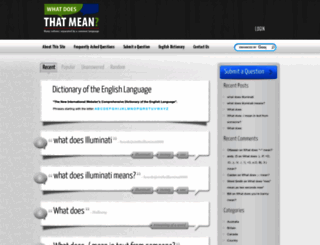
Visit whatdoesthatmean.comWe analyzed Whatdoesthatmean.com page load time and found that the first response time was 133 ms and then it took 1.1 sec to load all DOM resources and completely render a web page. This is quite a good result, as only 25% of websites can load faster.
whatdoesthatmean.com performance score
name
value
score
weighting
Value3.5 s
35/100
10%
Value7.9 s
3/100
25%
Value3.6 s
86/100
10%
Value260 ms
83/100
30%
Value0.299
40/100
15%
Value7.7 s
45/100
10%
133 ms
40 ms
24 ms
107 ms
14 ms
Our browser made a total of 42 requests to load all elements on the main page. We found that 86% of them (36 requests) were addressed to the original Whatdoesthatmean.com, 5% (2 requests) were made to Google.com and 5% (2 requests) were made to S.w.org. The less responsive or slowest element that took the longest time to load (321 ms) belongs to the original domain Whatdoesthatmean.com.
Page size can be reduced by 402.3 kB (65%)
614.5 kB
212.2 kB
In fact, the total size of Whatdoesthatmean.com main page is 614.5 kB. This result falls beyond the top 1M of websites and identifies a large and not optimized web page that may take ages to load. 30% of websites need less resources to load. Javascripts take 424.4 kB which makes up the majority of the site volume.
Potential reduce by 25.0 kB
HTML content can be minified and compressed by a website’s server. The most efficient way is to compress content using GZIP which reduces data amount travelling through the network between server and browser. HTML code on this page is well minified. It is highly recommended that content of this web page should be compressed using GZIP, as it can save up to 25.0 kB or 77% of the original size.
Potential reduce by 11.7 kB
Image size optimization can help to speed up a website loading time. The chart above shows the difference between the size before and after optimization. Obviously, Whatdoesthat Mean needs image optimization as it can save up to 11.7 kB or 14% of the original volume. The most popular and efficient tools for JPEG and PNG image optimization are Jpegoptim and PNG Crush.
Potential reduce by 306.7 kB
It’s better to minify JavaScript in order to improve website performance. The diagram shows the current total size of all JavaScript files against the prospective JavaScript size after its minification and compression. It is highly recommended that all JavaScript files should be compressed and minified as it can save up to 306.7 kB or 72% of the original size.
Potential reduce by 58.9 kB
CSS files minification is very important to reduce a web page rendering time. The faster CSS files can load, the earlier a page can be rendered. Whatdoesthatmean.com needs all CSS files to be minified and compressed as it can save up to 58.9 kB or 83% of the original size.
Number of requests can be reduced by 20 (50%)
40
20
The browser has sent 40 CSS, Javascripts, AJAX and image requests in order to completely render the main page of Whatdoesthat Mean. We recommend that multiple CSS and JavaScript files should be merged into one by each type, as it can help reduce assets requests from 5 to 1 for JavaScripts and as a result speed up the page load time.
www.whatdoesthatmean.com
133 ms
M9APdwnx1S8uqcxJ1THQdyzO9iyB8HTD8_NTUvPggqkFiXmpOfrFGflFJclAmWIkJrqigsT01PiS1NyCnMQSoMKsYv20xLzkyqT8Cv2swtLUoko9GF_XUM9Yz4SAflQuAA.css
40 ms
css
24 ms
M9bPKixNLarUMYYydHMz04sSS1L1cjPzdAz0HYuzPUv0UwsS81Jz9Isz8otKkvNTUov1s4r1U0viEQLxaUX5eSWpeSkA.js
107 ms
brand
14 ms
TcxBCsJADIXhC9lkCoLgzpUI3qGMQzqTsW3GJgG9vUVcdPk-Hn8xa2fEWOMbskieKDZWSDL_DCd-KNaX0_pxxh5O0P9n5wwzL1D1EPCiz5thVVRvtI6sZY_JR1m6LbDHO8XsNFzFCqfhGAJsJ_sC.js
140 ms
lcxBDoMwDAXRC5EYVC7AsqeoDHwQCTGGuAJuj1SpXZflzOKV1OT4NIKyYCblES9D0pkNmUKmgaU72-WgsL6xnR6cJxld5R9euYtFeRf49oeo_0RgTn_DDdsiBumLmnZ1SC16nya5AA.js
74 ms
brand
63 ms
wp-emoji-release.min.js
38 ms
header-bg.jpg
142 ms
wdtm_logo5.png
141 ms
header-bottom-bg.png
141 ms
search-bg-white.png
141 ms
search-icon.png
185 ms
content-bg.png
185 ms
right-shadow.png
186 ms
top-shadow.png
185 ms
separator-bg.png
185 ms
main-tabs-active.png
184 ms
active-arrow.png
218 ms
entry-bottom-page.png
222 ms
entry-top.png
217 ms
entry-content.png
220 ms
entry-bottom.png
221 ms
comment-number.png
221 ms
top-quote.png
253 ms
bottom-quote.png
252 ms
tag-bg.png
255 ms
sidebar-top.png
255 ms
sidebar-bottom.png
254 ms
sidebar-content.png
256 ms
button-bg.png
286 ms
facebook.png
286 ms
email.png
288 ms
rss.png
289 ms
sidebar-bullet.png
288 ms
footer-bg.png
290 ms
footer-top-bg.png
319 ms
footer-bottom-bg.png
321 ms
google_custom_search_watermark.gif
147 ms
2615.png
199 ms
262a.png
142 ms
whatdoesthatmean.com accessibility score
Navigation
These are opportunities to improve keyboard navigation in your application.
Impact
Issue
Heading elements are not in a sequentially-descending order
Names and labels
These are opportunities to improve the semantics of the controls in your application. This may enhance the experience for users of assistive technology, like a screen reader.
Impact
Issue
Image elements do not have [alt] attributes
<input type="image"> elements do not have [alt] text
Form elements do not have associated labels
Links do not have a discernible name
whatdoesthatmean.com best practices score
Trust and Safety
Impact
Issue
Does not use HTTPS
Ensure CSP is effective against XSS attacks
User Experience
Impact
Issue
Serves images with low resolution
General
Impact
Issue
Detected JavaScript libraries
Browser errors were logged to the console
whatdoesthatmean.com SEO score
Crawling and Indexing
To appear in search results, crawlers need access to your app.
Impact
Issue
robots.txt is not valid
Content Best Practices
Format your HTML in a way that enables crawlers to better understand your app’s content.
Impact
Issue
Image elements do not have [alt] attributes
![]()
EN
![]()
EN
UTF-8
Language claimed in HTML meta tag should match the language actually used on the web page. Otherwise Whatdoesthatmean.com can be misinterpreted by Google and other search engines. Our service has detected that English is used on the page, and it matches the claimed language. Our system also found out that Whatdoesthatmean.com main page’s claimed encoding is utf-8. Use of this encoding format is the best practice as the main page visitors from all over the world won’t have any issues with symbol transcription.
whatdoesthatmean.com
Open Graph description is not detected on the main page of Whatdoesthat Mean. Lack of Open Graph description can be counter-productive for their social media presence, as such a description allows converting a website homepage (or other pages) into good-looking, rich and well-structured posts, when it is being shared on Facebook and other social media. For example, adding the following code snippet into HTML <head> tag will help to represent this web page correctly in social networks: